The Lordship of Bowland
The activities of the current Lord of Bowland are reviving a long-dormant influence and interest in the Forest of Bowland and its people. This page tries to keep up with those activities and maintain a brief record of items of interest.

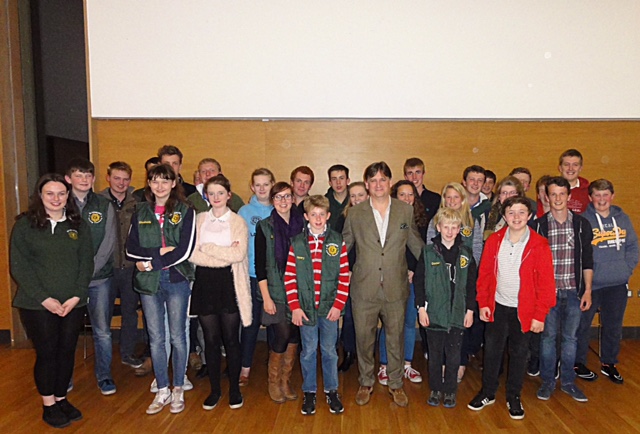
Lord of Bowland stands up for Young Farmers
The notoriously camera-shy William Bowland, a former Young Farmer himself, was accompanied by Helen Wallbank, of the Slaidburn Village Archive.
Jess Dodd, of the Slaidburn Young Farmers, said:"As Young Farmers, we care passionately about the land and many of us want to farm in Bowland in the future. It's absolutely great that the Lord of Bowland is there to champion our interests and stand up for Young Farmers".
Helen Wallbank, of the Slaidburn Village Archive, added:"We have had a Lord of Bowland for more than 900 years. We believe it is important that young people understand the history and traditions of where they live. This visit by the Lord of Bowland is a very special occasion for the Slaidburn Young Farmers Club and we are very grateful to William Bowland for giving freely of his time in this way".
The visit took place during the week when the Lord of Bowland hosted his fifth annual lecture, at which Lakeland composer Christopher Gibbs talked about the inspiration behind his famous "Forest of Bowland" suite.
WHO NEEDS A LORD OF BOWLAND?
William Bowland
(This article was originally published in The Slaidburn Villager, February-March 2015.)
The age of feudalism has passed. We live in an age of democracy and equality. We are all free men and women. So, why on earth does the Forest need a Lord, let alone a 16th Lord also known as the Lord of the Fells with a baby son styled the Master of Bowland? Isn't it all a bit silly and, well, out-of-date? And what is all this stuff about Bowbearers and Chief Stewards? The answer of course is strictly speaking the Forest doesn't need a Lord at all. No-one likes the idea of someone thinking he is better than the next man or looking down his nose at others. But anyone who thinks today's Lordship of Bowland is about snobbery misses the point entirely.
The Lordship is not a title of nobility. It is a feudal lordship, a piece of ancient property, and it is one of England's oldest - almost 1000 years old. King William Rufus, son of the Conqueror, bestowed the title on one of his nobles, Roger de Poitou, in the late C11th. There have been more than 40 lords since then, including 16 monarchs (the so-called "Lord Kings of Bowland"), seven dukes, an earl and a baron. After 1885, the Lordship disappeared into a Towneley family trust before being claimed by Lord O'Hagan, a Towneley descendant, in 2008.
Like other Lords before me, including the famous Peregrine Towneley in 1835, I became Lord of Bowland by "private treaty". Like Peregrine, I bought the title but in my case, I did so to prevent it disappearing into the possession of some uncaring rich businessman or foreign buyer. My roots in the Forest stretch back to the late 1600s and I have worked with the folk at the Forest of Bowland AONB, the Slaidburn Archive and the Friends of Bowland to put this extraordinary piece of Forest history to work in the service of our community.
Only last month, the Slaidburn Archive organised for me to visit Brennands and Thorneyholme schools to talk to the pupils about their heritage, including the Lordship, in the company of Robert Parker of Browsholme Hall, the 10th member of his family to be Bowbearer to the Lords of Bowland. What a privilege and how wonderful to see such enthusiasm and engagement from our young children.
Late last year, I agreed to sponsor the Forest of Bowland AONB 50th Anniversary Vibrant Community Award. My Chief Steward of the Forest, Michael Parkinson, a much-respected land agent who has worked in Bowland almost all his working life and acted as Steward to both Lord Clitheroe and Sir Simon Towneley, presented the Award on my behalf at a gala dinner at Clough Bottom. The worthy winner was the Slaidburn Village Archive.
There have been my four Lord of Bowland Lectures, held annually in October, where Bowlanders have had an opportunity to rediscover the history of Newton and its chapel; the origins and role of the old Slaidburn courthouse; the history of the medieval hunting Forest; and of course, the Lordship itself. A new Bowland road sign has been ceremonially unveiled at Dunsop Bridge; a legacy secured for the Village Archive to help it continue its important research; and most recently, l was given the task of formally welcoming the University of Cambridge Lancashire Society to a luncheon at Clitheroe Castle, one-time seat of the Lords of Bowland.
We know there are always going to be those unhappy souls who like to sneer and snipe. But the Lordship of Bowland isn't about "pomp and flunkery". It is about acknowledging our shared past with pride and creating a better future. We should celebrate the Lordship as a part of our heritage just as we might celebrate an historic landscape or a beautiful building. Let's use it to help protect, preserve and promote Bowland in all its glory. The 16th Lord of Bowland should be regarded as just another feature of our wonderful Area of Outstanding Natural Beauty, no more, no less.
And in truth that can be the only reason why in the 21st century the Forest of Bowland needs a Lord at all ...